
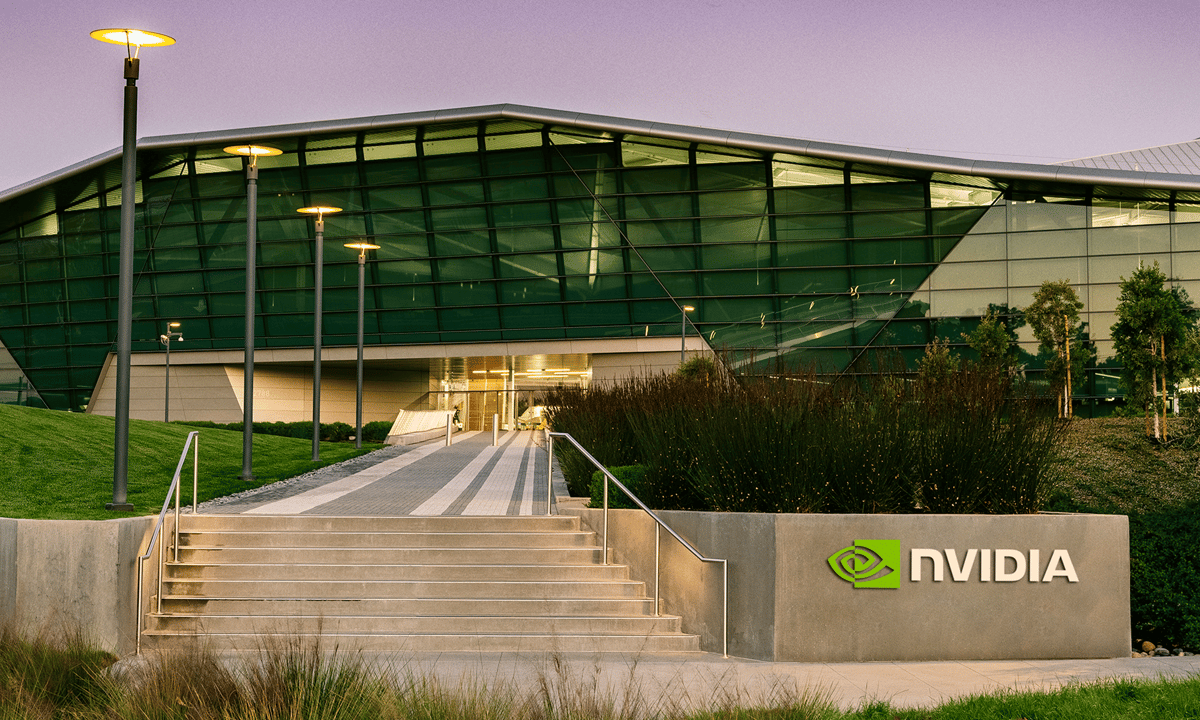
Nvidia Faces Bullish $322 Price Target on Blackwell Revenue Boom
Nvidia stock could surge to $322 per share by the end of 2026—a stunning 77% increase from current levels—according to a detailed financial projection based on the company's artificial intelligence chip roadmap. The bullish forecast hinges on CEO Jensen Huang's ambitious vision of generating $1 trillion in annual revenue from the company's next-generation Blackwell and Vera Rubin chip lines by the end of 2027, fundamentally reshaping the artificial intelligence infrastructure market and cementing Nvidia's position as the dominant supplier of AI computing power.
The analysis underlying this price target applies consistent financial assumptions that reveal how the market is likely to value Nvidia if the company executes its product roadmap successfully. The projection assumes:
- 13% sequential quarterly revenue growth throughout the forecast period
- A constant price-to-sales (P/S) ratio of 21x, implying the market maintains confidence in the company's profitability and growth trajectory
- Revenue scaling from current levels toward the $1 trillion annual run rate targeted for late 2027
These assumptions are neither conservative nor wildly aggressive—they represent a disciplined extrapolation of Nvidia's demonstrated execution capability and the explosive demand for AI infrastructure that has characterized the company's business since the launch of ChatGPT and the subsequent AI boom.
The Blackwell Bet: Revolutionary Chips Driving the Revenue Forecast
The entire $322 price target narrative rests on the successful commercialization and market penetration of Nvidia's Blackwell architecture, which represents the company's most significant generational leap since the introduction of its CUDA programming platform. Blackwell chips promise dramatically improved performance per watt, reduced latency, and enhanced efficiency for training and inference of large language models—the core workload driving the current AI infrastructure cycle.
Vera Rubin, the successor architecture already in development, represents Nvidia's commitment to maintaining technological leadership beyond 2026. By positioning these two chip families as the revenue engine that will generate $1 trillion annually, Huang is signaling confidence that AI adoption will accelerate across cloud providers, enterprises, and new applications not yet fully imagined.
The path to $1 trillion in revenue is extraordinarily aggressive. For context, Nvidia's total revenue in fiscal 2024 reached approximately $60 billion, meaning the company would need to grow revenue by roughly 1,600% over three years. While this sounds extraordinary, it's worth noting that Nvidia has already demonstrated the capacity for explosive growth—the company achieved approximately 126% year-over-year revenue growth in fiscal 2024, driven primarily by data center AI accelerator demand.
Market Context: Competitive Threats and Execution Risk
However, the path to $322 per share is far from assured, and the analysis appropriately acknowledges significant headwinds that could derail the bullish thesis. The artificial intelligence chip market has attracted aggressive competition from multiple directions:
Competitive Landscape:
- AMD ($AMD) has announced aggressive EPYC and MI-series GPU roadmaps aimed at capturing AI training and inference workloads
- Intel ($INTC) is repositioning itself as an AI infrastructure provider with Gaudi accelerators and next-generation Xeon processors
- Custom ASICs from major cloud providers including Google, Amazon, and Microsoft are increasingly viable alternatives to Nvidia's general-purpose GPUs
- Qualcomm ($QCOM), Broadcom ($AVGO), and emerging startups are developing specialized chips for specific AI workloads
The emergence of custom silicon represents perhaps the most significant long-term threat to Nvidia's monopolistic pricing power. Major hyperscalers are motivated to reduce dependency on Nvidia as their AI infrastructure costs scale. Each point of market share lost to competitive alternatives directly impacts the achievable revenue and profitability necessary to justify the $322 price target.
Beyond competitive dynamics, macroeconomic uncertainty looms large. The projection assumes uninterrupted 13% sequential quarterly growth extending through 2026—a assumption vulnerable to:
- Interest rate shocks that reduce capital expenditure by cloud providers
- Recessionary conditions dampening enterprise AI spending
- Oversupply dynamics if the AI infrastructure buildout plateaus before demand fully materializes
- Regulatory constraints on AI export, particularly to China, which previously represented a meaningful portion of Nvidia's data center revenue
Why This Matters for Investors: Opportunity and Risk
The $322 price target serves as a useful analytical framework for understanding how Nvidia shares are likely to behave conditional on successful execution of the company's AI chip strategy. For investors, several key implications emerge:
Bullish Case: If Nvidia maintains its technological lead, sustains GPU adoption among cloud providers despite custom silicon alternatives, and executes the Blackwell transition flawlessly, the fundamentals supporting a $322 valuation become increasingly plausible. The company's fortress balance sheet, dominant installed base, and first-mover advantages in GPU computing create powerful network effects that are difficult for competitors to overcome.
Bearish Case: Intensifying competition, faster-than-expected custom ASIC adoption, or macroeconomic softening could dramatically compress Nvidia's valuation multiples. If the price-to-sales ratio compresses from 21x to 15x, or if the revenue growth trajectory slows materially, the stock could underperform even if absolute revenue grows significantly.
Valuation Reflection: The analysis assumes the market will assign a constant 21x P/S ratio to Nvidia throughout the forecast period. Given that high-growth technology companies typically experience multiple compression as they mature, this assumption may prove optimistic. Nvidia might generate the projected revenues while the stock appreciates less than 77% if investors become more cautious about valuation.
The artificial intelligence boom represents a multi-year, possibly multi-decade transformation of computing infrastructure. Nvidia's position as the primary beneficiary of this transition is well-established, but the path from current valuation to $322 per share requires both continued execution excellence and benign competitive and macroeconomic conditions that remain far from guaranteed.
Investors should view this $322 target not as a prediction, but as a useful baseline scenario illustrating how Nvidia's business fundamentals could translate into equity value under optimistic assumptions. The actual outcome will depend on factors ranging from geopolitical risk to the pace of AI adoption to the success of competitors in developing viable alternatives to Nvidia's GPU architecture—variables that will shape not just Nvidia's future, but the infrastructure foundation of artificial intelligence itself.