
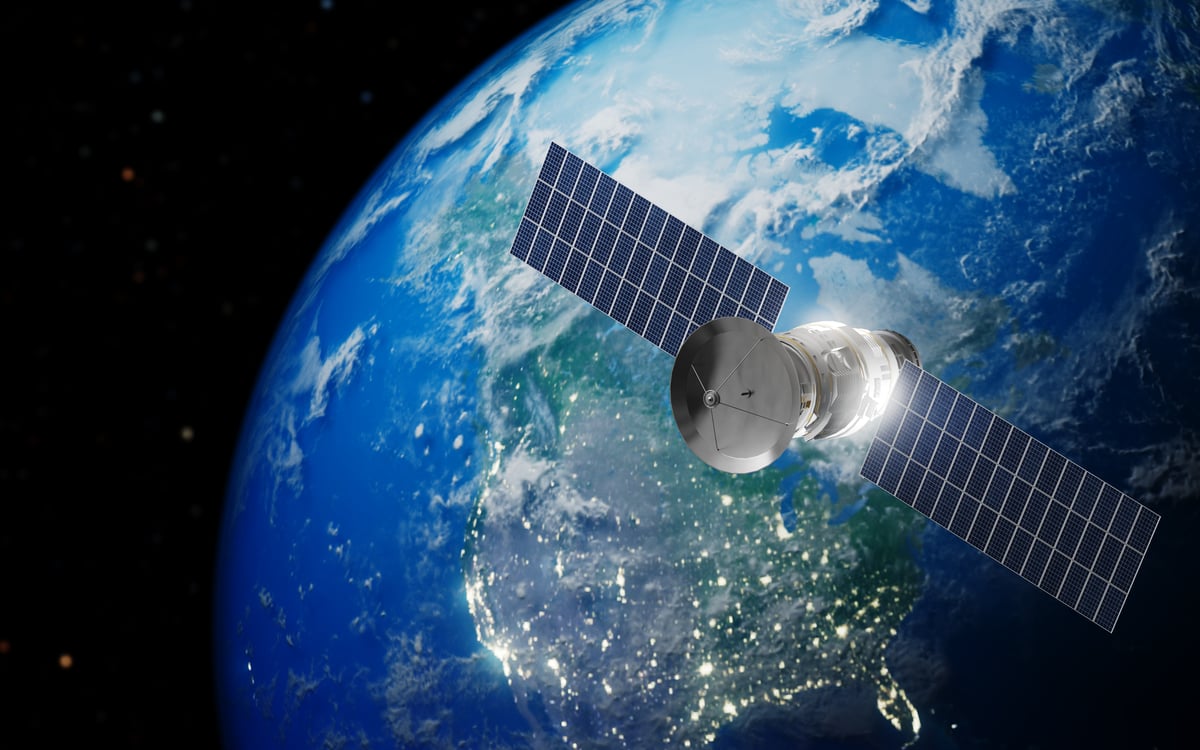
SpaceX Eyes Historic IPO with $1.5 Trillion Valuation Target
SpaceX is preparing for a landmark initial public offering in 2026 at a valuation of $1.5 trillion or higher, potentially making it one of the most valuable companies ever brought to public markets. While retail investors typically cannot access pre-IPO companies directly, a significant spectrum deal has created an unexpected investment avenue: EchoStar Corporation ($SATS), which received $11 billion in SpaceX stock as part of a broader $19.5 billion spectrum transaction. This development offers sophisticated investors a potential pathway to gain exposure to Elon Musk's rocket company before its public debut.
The arrangement stems from EchoStar's involvement in a spectrum-sharing agreement with SpaceX, where the satellite communications company accepted equity stakes in lieu of cash payments. This structure is relatively uncommon in the telecommunications sector and reflects both the strategic value of the partnership and the private equity markets' appetite for SpaceX shares at astronomical valuations. For investors seeking pre-IPO exposure to the aerospace pioneer, $SATS represents one of the few publicly traded vehicles with direct holdings in the private space exploration company.
Valuation Concerns Temper the Investment Case
Despite the excitement surrounding SpaceX's growth trajectory and market dominance in commercial spaceflight, financial analysts have raised significant concerns about the company's valuation metrics. At its reported $1.5 trillion valuation, SpaceX is trading at a price-to-sales ratio of approximately 100—a figure that vastly exceeds traditional aerospace and defense industry comparables and even most high-growth technology companies.
These valuation concerns are compounded by several structural risks:
- Twitter liability exposure: SpaceX's parent holding company structure ties it to Elon Musk's X (formerly Twitter), which has faced significant operational and financial challenges since his acquisition
- xAI subsidiary obligations: The company's involvement in xAI, the artificial intelligence venture, introduces additional liabilities and capital commitments
- Capital intensity: Ongoing investments in Starship development, global satellite internet expansion, and next-generation rocket technology require enormous sums
- Regulatory uncertainty: Government relationships and defense contracts represent both opportunities and risks in a shifting geopolitical landscape
The 100x price-to-sales multiple suggests the market has already priced in extraordinary growth assumptions and successful execution of multiple moonshot objectives simultaneously. For comparison, Lockheed Martin ($LMT), the aerospace and defense giant, trades at roughly 1.5x sales, while Boeing ($BA) hovers around 0.8x sales.
Market Context: The Aerospace Sector and Pre-IPO Trends
SpaceX's planned 2026 IPO arrives at a transformative moment for the aerospace and defense industry. Commercial space services have evolved from an experimental niche to a critical economic sector, with applications ranging from national security to telecommunications to scientific research. SpaceX itself has become the dominant player in commercial launch services, with its Falcon 9 rocket accounting for the vast majority of active U.S. orbital launches.
The broader institutional market has demonstrated enormous appetite for space-related investments. Venture capital and private equity firms have backed numerous space startups, while traditional aerospace companies like Lockheed Martin, Northrop Grumman ($NOG), and Raytheon Technologies ($RTX) have all expanded their commercial space divisions. The $1.5 trillion valuation reflects genuine excitement about the long-term potential of space commerce, satellite internet, space tourism, and deep-space exploration.
However, SpaceX's pre-IPO valuation has evolved rapidly. The company was valued at approximately $180 billion in 2021 and reached $210 billion by 2023, before the current $1.5 trillion estimate—representing more than a 7x increase in valuation in just a few years. This trajectory raises questions about whether valuations are driven by fundamental progress or speculative fervor.
The EchoStar arrangement is particularly noteworthy because it provides rare transparency into SpaceX's private equity ecosystem. Most pre-IPO unicorns remain largely opaque to public market investors. By accepting $11 billion in SpaceX stock from a $19.5 billion total deal, EchoStar effectively leveraged its spectrum assets to gain significant exposure to the company while preserving cash flexibility. This structure mirrors strategies used in biotechnology and technology ventures where equity compensation substitutes for cash outlays.
What This Means for Investors
For $SATS shareholders, the SpaceX stake represents both an asymmetric upside opportunity and a significant concentration risk. EchoStar is not a pure-play SpaceX proxy—it remains a satellite communications company with its own operational and financial challenges. However, the $11 billion valuation of the SpaceX position likely represents a meaningful portion of EchoStar's overall enterprise value, making it a leveraged bet on SpaceX's success.
Retail investors considering $SATS as a pre-IPO SpaceX play should weigh several factors:
- Liquidity and complexity: Holding $SATS provides indirect exposure, but converting this position into cash requires navigating EchoStar's overall business operations
- Valuation disconnect: EchoStar's public market valuation may not fully reflect the embedded SpaceX stake due to business complexity or investor confusion
- Timeline uncertainty: The 2026 IPO date for SpaceX is not guaranteed and could face delays due to regulatory or market conditions
- Risk concentration: Betting on SpaceX through $SATS introduces exposure to satellite communications industry headwinds alongside space exploration opportunities
Direct investment in SpaceX remains unavailable to retail investors ahead of the 2026 IPO. $SATS represents a creative but indirect approach. Traditional aerospace and defense ETFs or individual holdings in $LMT, $NOG, and $RTX offer more straightforward exposure to industry growth themes, though without the concentrated SpaceX bet.
Forward Look: The 2026 IPO and Market Dynamics
SpaceX's approach to going public—if the 2026 timeline holds—will likely reshape investor expectations for space-economy companies. A successful IPO at or near $1.5 trillion would validate the current private valuation but could also trigger a critical revaluation if the public markets price the shares more conservatively than private investors have.
The EchoStar situation serves as a preview of how SpaceX equity ownership will distribute across financial stakeholders when the company eventually enters public markets. Whether $SATS holders benefit handsomely or face disappointment may depend less on SpaceX's fundamental achievements and more on whether the company's public market valuation aligns with current expectations. The 100x price-to-sales ratio leaves little room for disappointment.