
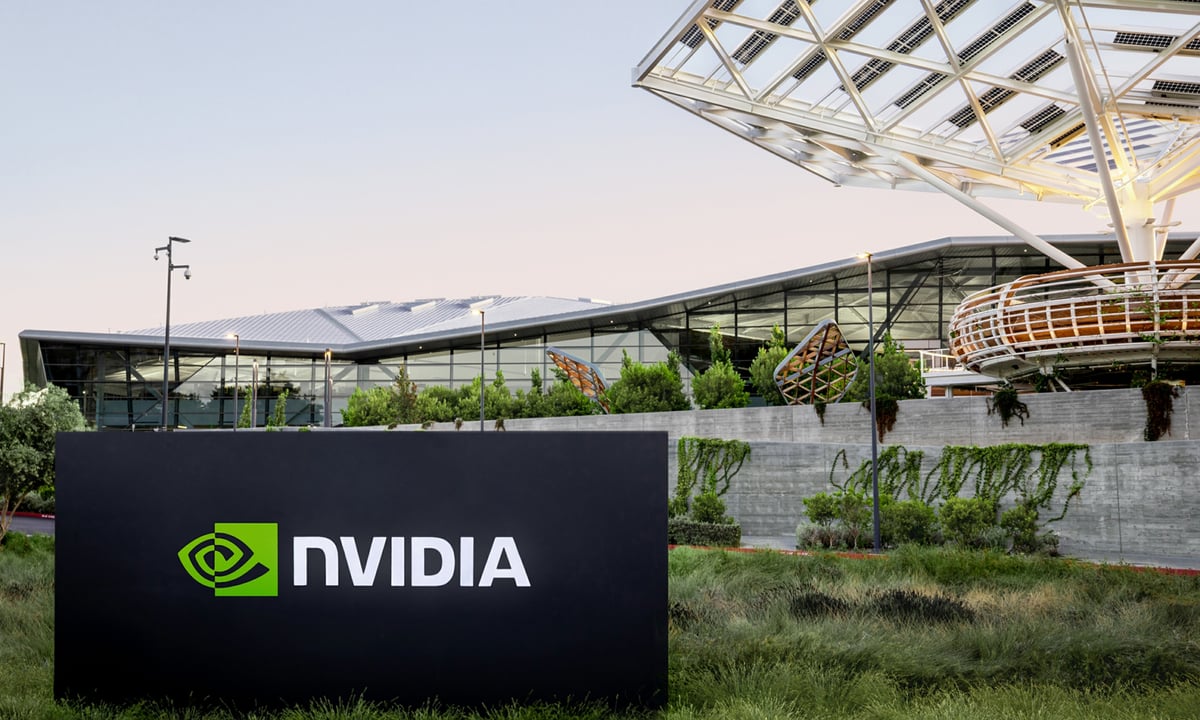
AI Giants Trading Below Fair Value as Nvidia, Meta Scale Aggressively
While the artificial intelligence sector has faced headwinds in 2026, two of the market's most dominant players—Nvidia ($NVDA) and Meta Platforms ($META)—are defying the broader sell-off by trading at significant valuation discounts despite accelerating business momentum. The paradox presents a compelling opportunity for long-term investors: both companies are scaling their operations at unprecedented rates while their stock valuations have retreated from historical highs, creating a rare misalignment between market sentiment and fundamental performance.
The disconnect is particularly striking given the extraordinary financial metrics both companies are generating. Nvidia, the undisputed leader in AI semiconductors, reported record revenues of $215.9 billion, representing a stunning 65% year-over-year increase. Looking ahead, the chip designer expects to generate $78 billion in revenue during Q1 FY2027 alone—a quarterly figure that would rank among the largest single quarters in corporate history. More tellingly, Nvidia maintains a commanding 92% market share in GPU processors, the essential hardware powering the AI revolution. Yet despite these extraordinary results, $NVDA trades at forward price-to-earnings multiples that have compressed relative to historical averages, suggesting the market has priced in skepticism about sustained growth.
The Numbers Behind the Opportunity
Nvidia's dominance extends across the entire AI infrastructure ecosystem. The company's GPU market share of 92% represents near-monopolistic control over the hardware layer that every major AI model—from OpenAI's systems to Google's Gemini and enterprise deployments worldwide—depends upon. The $215.9 billion in annual revenue dwarfs previous records and underscores the massive capital deployment occurring globally as corporations race to build AI capabilities.
The Q1 FY2027 guidance of $78 billion in quarterly revenue deserves particular emphasis. To contextualize: this single quarter would generate more revenue than most Fortune 500 companies produce annually. If sustained, such levels would imply annual revenues approaching $310+ billion, placing Nvidia among the highest-revenue companies in human history. The demand visibility reflected in this guidance suggests customers are not pulling back on AI infrastructure investments despite near-term market volatility.
Meta's AI transformation tells an equally compelling story, though through a different lens. Rather than selling the picks and shovels of AI infrastructure, Meta is embedding artificial intelligence directly into its user-facing products that reach 3 billion monthly active users across Facebook, Instagram, and WhatsApp. The company is directing AI systems toward advertising efficiency and product recommendations—areas where even marginal improvements compound into substantial revenue gains. To fuel this ambition, Meta plans to deploy $135 billion in capital expenditure on AI infrastructure during 2026—a figure that dwarfs the R&D budgets of most technology companies and rivals the annual revenues of major corporations.
This massive infrastructure investment serves a strategic dual purpose: it positions Meta's own generative AI capabilities to compete with standalone AI firms while simultaneously improving the efficiency of its core advertising business, which generates the vast majority of the company's $114+ billion in annual revenue (as of recent fiscal year results).
Market Context: Why Valuations Have Compressed
The broader AI sector sell-off reflects profit-taking and rising skepticism about near-term returns on massive capital investments. After the explosive 2023-2024 period when AI stocks reached stratospheric valuations, investors have begun questioning whether the hundreds of billions being spent on data centers, training infrastructure, and AI development will generate commensurate returns. GPU prices have stabilized as supply has increased, and concerns persist about whether demand growth can sustain the pace required to justify current capex levels.
Yet Nvidia and Meta present exceptions to this cautionary narrative. Unlike many AI-adjacent companies making speculative bets on emerging use cases, both firms operate within markets with demonstrable unit economics and measurable return on invested capital:
- Nvidia's position is structural: Its GPU monopoly cannot be easily displaced, and the company benefits from every dollar of AI infrastructure spending globally
- Meta's efficiency plays are concrete: Every percentage-point improvement in advertising targeting translates directly into revenue and margin expansion among an enormous installed base
The current valuation compression appears to reflect indiscriminate AI sector weakness rather than company-specific deterioration. Investors have grouped Nvidia and Meta with speculative AI plays, despite the two companies' vastly different risk profiles and return visibility.
What This Means for Long-Term Investors
The forward price-to-earnings multiples for both stocks have contracted below their historical averages, according to the data, creating an asymmetric risk-reward for patient capital. Consider the implications:
-
Nvidia at compressed valuations gains margin of safety: Even if GPU growth moderates from current 65% YoY rates, the company's $78 billion quarterly guidance suggests a multi-year runway of capacity expansion and pricing power. The 92% market share provides structural protection against commoditization.
-
Meta's $135 billion capex commitment signals conviction: The company is not hedging its AI bet; it is doubling down despite market skepticism. History suggests Meta's capital allocation decisions, while aggressive, have generally created shareholder value—consider the company's successful pivot to mobile and subsequent dominance of mobile advertising.
Both firms benefit from the same secular trend: the AI infrastructure buildout has barely begun. Current data center capacity is insufficient for the wave of enterprise AI deployment, model training cycles, and inference workloads that will accumulate over the next 3-5 years. When future earnings emerge from these investments—via higher Nvidia revenues from increased GPU demand or Meta's improved advertising conversion rates—investors who purchased at compressed valuations will likely realize substantial returns.
The sell-off has created a window where quality companies with proven market position, massive growth visibility, and strengthening business fundamentals are trading at discounted valuations. This represents precisely the kind of opportunity that long-term value investors monitor. The AI infrastructure build is far from complete, and the companies enabling and monetizing it most effectively are trading cheaper than their growth rates and market positions would typically justify. For investors with a multi-year horizon and conviction in AI's transformational potential, the current market dynamics merit serious consideration.