
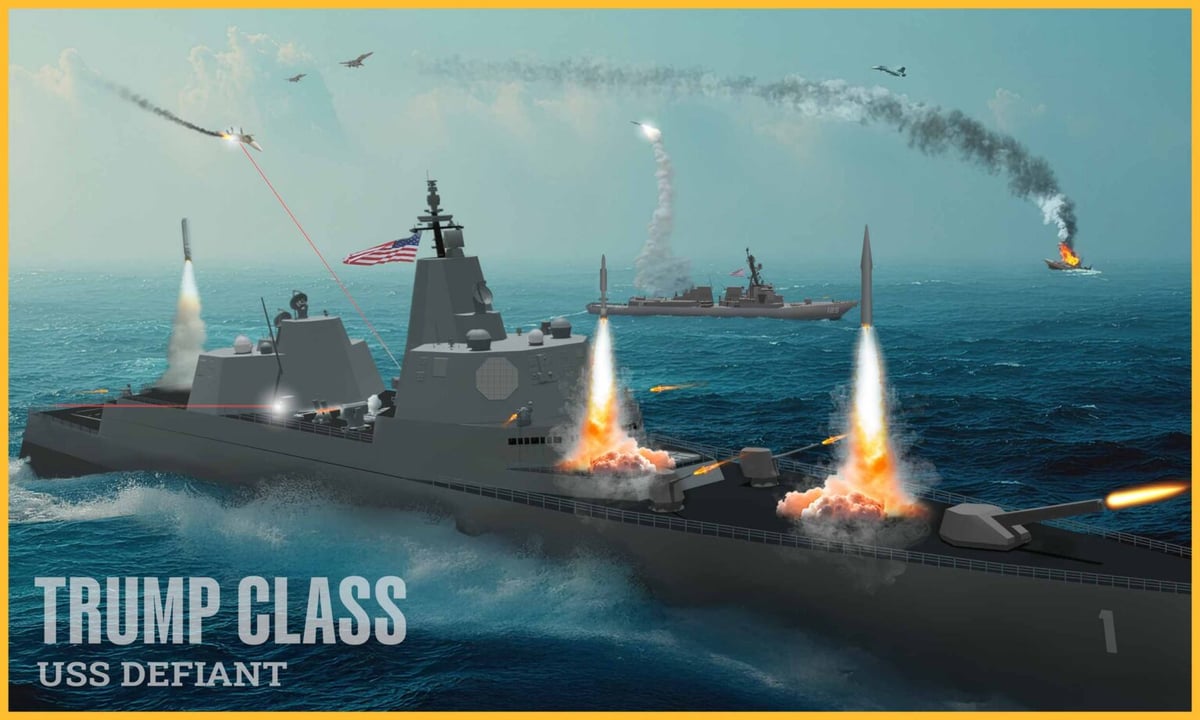
Trump Orders Navy's First Railgun Battleship: A Decade-Long Defense Windfall Begins
President Trump has ordered the U.S. Navy to construct USS Defiant, a new battleship equipped with cutting-edge electromagnetic railgun technology, marking a significant shift in naval strategy and opening substantial opportunities for defense contractors. The directive represents a bold pivot toward advanced weaponry at a time when naval modernization has become a strategic priority amid great-power competition. With development timelines stretching over a decade, this project could generate billions in contracts and reshape the competitive landscape of America's defense industrial base.
The Railgun Revolution Takes Shape
The USS Defiant represents one of the most ambitious naval modernization initiatives in recent memory. The electromagnetic railgun—a weapon system that accelerates projectiles using electrical force rather than traditional propellant—has long captured military planners' imaginations due to its superior range, speed, and reduced logistics burden compared to conventional naval guns.
Key specifications and expectations for the program include:
- Development timeline: Over a decade from authorization to operational status
- Primary contractors: BAE Systems currently leads U.S. prototype development efforts, with General Atomics also positioned as a significant competitor
- Technology focus: Electromagnetic railgun systems integrated into a newly designed battleship platform
- Strategic significance: Represents Pentagon's commitment to maintaining technological superiority in naval warfare
The Pentagon's renewed emphasis on railgun development comes after years of relative dormancy in the program. BAE Systems, already a major player in advanced weapons systems and naval technologies, has emerged as the frontrunner in prototype development. The company's existing expertise in power systems, materials science, and naval integration positions it favorably for the primary construction contract. General Atomics, known for its work in electromagnetic systems and advanced defense technologies, has signaled serious interest in competing for portions of this lucrative program, particularly in subsystems and component manufacturing.
The extended development and construction timeline—over a decade—reflects the genuine complexity of integrating emerging railgun technology into a fully operational naval vessel. This extended horizon suggests sustained revenue streams for successful bidders rather than a single-year spike, making it an attractive long-term opportunity for defense contractors and their investors.
Market Context and Strategic Drivers
The USS Defiant initiative arrives at a critical juncture in American naval strategy. As the U.S. Navy faces increasing pressure to modernize its aging fleet and maintain technological advantages against peer competitors, particularly China's expanding naval capabilities, the push for next-generation weapons systems has intensified significantly.
Several factors have converged to make this moment propitious for railgun investment:
- Geopolitical tensions: Rising concerns about great-power competition in the Indo-Pacific have accelerated funding for advanced naval systems
- Technological maturity: Prototype railgun systems have advanced sufficiently to justify integration into operational platforms
- Budget environment: Defense spending remains robust, with bipartisan support for naval modernization initiatives
- Industrial capacity: U.S. defense contractors have demonstrated capability to manage complex, multi-year weapons programs
The broader defense sector has increasingly pivoted toward advanced technologies like directed-energy weapons, autonomous systems, and AI-enhanced capabilities. The USS Defiant project signals that electromagnetic railguns have moved from theoretical research into concrete procurement strategy. This legitimization could unlock additional funding for related research and development across the defense industrial base.
Traditional naval shipbuilders, including Huntington Ingalls Industries and General Dynamics, may also benefit as major subsystems integrators or as providers of hull and platform technologies. The project's scope suggests that multiple tiers of defense contractors will participate in different aspects of design, manufacturing, and integration.
Investor Implications and Stock Opportunities
For investors tracking defense stocks, the USS Defiant program represents a meaningful long-term growth driver. Companies positioned to capture portions of this contract have clearly defined, multi-decade revenue visibility—a rare commodity in the defense sector.
BAE Systems ($BA) stands as the most obvious beneficiary, given its current leadership in U.S. railgun prototype development. The company's proven ability to manage complex, classified weapons programs and its existing relationships with Navy leadership provide substantial competitive advantages. For shareholders, this project could represent a floor of sustainable revenue growth extending well into the 2030s and potentially beyond.
General Atomics, though privately held, remains worth monitoring for potential public market activity. Defense investors should track any announcements regarding the company's involvement in USS Defiant subsystems or whether it pursues strategic partnerships with larger public contractors that might serve as vehicles for exposure.
Secondary beneficiaries include specialized materials manufacturers, advanced electronics suppliers, and power systems integrators. Companies specializing in superconductor technology, advanced composite materials, and high-capacity electrical systems could see increased demand driven by railgun integration requirements.
The project timeline deserves emphasis for risk management purposes. With development stretching beyond a decade, investors must account for potential technical delays, budget revisions, and shifting strategic priorities. However, the political commitment behind the initiative and the broad bipartisan support for naval modernization suggest that major delays remain unlikely.
This initiative also carries broader implications for the defense sector's technology adoption curve. A successful USS Defiant program could accelerate timeline for railgun adoption across allied navies and potentially inspire similar advanced-technology initiatives across military branches. This demonstration effect could amplify the total addressable market for railgun-related technologies and supporting systems.
Looking Forward: A Multi-Decade Opportunity
The Trump administration's order for USS Defiant marks a significant milestone in transitioning electromagnetic railgun technology from experimental programs into operational naval doctrine. For the defense industrial base, this represents a generational opportunity spanning design, manufacturing, testing, and operational deployment across more than ten years.
The project's scale, complexity, and strategic importance suggest sustained political and budgetary support regardless of which administration oversees implementation. Defense contractors and their investors should begin positioning for what promises to be one of the most consequential naval modernization programs of the coming decade. Companies demonstrating technical expertise in electromagnetic systems, advanced materials integration, and complex weapons platform management will likely emerge as long-term winners in this high-stakes competition.
As the program moves from announcement to procurement, investors should monitor contract awards, test results, and competitive positioning closely. The USS Defiant is unlikely to be the last advanced-technology warship the Navy commissions—initial success may well catalyze follow-on orders, transforming this single vessel into the foundation of an entirely new class of American naval power.